 Cookies
Potřebujeme váš souhlas k využití jednotlivých dat, aby se vám mimo jiné mohly ukazovat informace týkající se vašich zájmů. Souhlas udělíte kliknutím na tlačítko „OK“.
ASTM E1226-12
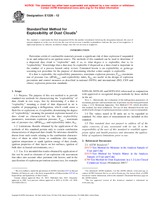
Standard Test Method for Explosibility of Dust Clouds
Automaticky přeložený název:
Standardní zkušební metoda pro výbušnosti rozvířeného prachu
NORMA vydána dne 15.5.2012
Informace o normě:
Označení normy: ASTM E1226-12
Poznámka: NEPLATNÁ
Datum vydání normy: 15.5.2012
Kód zboží: NS-40933
Počet stran: 12
Přibližná hmotnost: 36 g (0.08 liber)
Země: Americká technická norma
Kategorie: Technické normy ASTM
Anotace textu normy ASTM E1226-12 :
Keywords:
dust explosion, explosion pressure, ICS Number Code 13.230 (Explosion protection), 17.100 (Measurement of force, weight and pressure)
Doplňující informace
| Significance and Use | ||||||||||
|
This test method provides a procedure for performing laboratory tests to evaluate deflagration parameters of dusts. The data developed by this test method may be used for the purpose of sizing deflagration vents in conjunction with the nomographs and equations published in NFPA 68, ISO 6184/1, or VDI 3673. The values obtained by this testing technique are specific to the sample tested and the method used and are not to be considered intrinsic material constants. For hard-to-ignite dusts with low KSt-values, a very strong ignitor may overdrive a 20-L chamber, as discussed in E1515 and Ref (1). If a dust has measurable (nonzero) Pmax- and KSt-values with a 5000 or 10 000-J ignitor but not with a 2500-J ignitor in a 20-L chamber, this may be an overdriven system. In this case, it is recommended that the dust be tested with a 10 000-J ignitor in a larger chamber such as a 1-m3 chamber to determine if it is actually explosible. |
||||||||||
| 1. Scope | ||||||||||
|
1.1 Purpose. The purpose of this test method is to provide standard test methods for characterizing the “explosibility” of dust clouds in two ways, first by determining if a dust is “explosible,” meaning a cloud of dust dispersed in air is capable of propagating a deflagration, which could cause a flash fire or explosion; or, if explosible, determining the degree of “explosibility,” meaning the potential explosion hazard of a dust cloud as characterized by the dust explosibility parameters, maximum explosion pressure, Pmax ; maximum rate of pressure rise, (dP/dt)max; and explosibility index, KSt. 1.2 Limitations. Results obtained by the application of the methods of this standard pertain only to certain combustion characteristics of dispersed dust clouds. No inference should be drawn from such results relating to the combustion characteristics of dusts in other forms or conditions (for example, ignition temperature or spark ignition energy of dust clouds, ignition properties of dust layers on hot surfaces, ignition of bulk dust in heated environments, etc.) 1.3 Use. It is intended that results obtained by application of this test be used as elements of an explosion risk assessment that takes into account other pertinent risk factors; and in the specification of explosion prevention systems (see, for example NFPA 68, NFPA 69, and NFPA 654) when used in conjunction with approved or recognized design methods by those skilled in the art. Note 1—Historically, the evaluation of the deflagration parameters of maximum pressure and maximum rate of pressure rise has been performed using a 1.2-L Hartmann Apparatus. Test Method E789, which describes this method, has been withdrawn. The use of data obtained from the test method in the design of explosion protection systems is not recommended. 1.4 The values stated in SI units are to be regarded as standard. No other units of measurement are included in this standard. 1.5 This standard does not purport to address all of the safety concerns, if any, associated with its use. It is the responsibility of the user of this standard to establish appropriate safety and health practices and determine the applicability of regulatory limitations prior to use. |
||||||||||
| 2. Referenced Documents | ||||||||||
|
Odebírejte informace o nově vydaných normách ZDARMA:
Chcete pravidelně odebírat informace o nově vycházejících normách z celého světa a to zcela zdarma?
Přihlašte se k odběru. Vše je velice jednoduché a absolutně ZDARMA.
Na výběr máte vydavatele z celého světa.