 Cookies
Potřebujeme váš souhlas k využití jednotlivých dat, aby se vám mimo jiné mohly ukazovat informace týkající se vašich zájmů. Souhlas udělíte kliknutím na tlačítko „OK“.
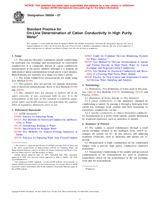
ASTM D6504-07
Standard Practice for On-Line Determination of Cation Conductivity in High Purity Water
Automaticky přeložený název:
Standardní praktiky pro On -Line Stanovení kationtu vodivosti ve vysoké čistotě vody
NORMA vydána dne 15.6.2007
Informace o normě:
Označení normy: ASTM D6504-07
Poznámka: NEPLATNÁ
Datum vydání normy: 15.6.2007
Kód zboží: NS-35411
Počet stran: 6
Přibližná hmotnost: 18 g (0.04 liber)
Země: Americká technická norma
Kategorie: Technické normy ASTM
Anotace textu normy ASTM D6504-07 :
Keywords:
boiler cycle chemistry, cation conductivity, on-line, process measurement, ICS Number Code 13.060.60 (Examination of water for physical properties)
Doplňující informace
| Significance and Use | ||||||||||||||||||
|
Cation conductivity provides one of the most sensitive and dependable on-line means of detecting anionic contamination in the boiler/steam cycle, such as chlorides, sulfates, nitrates, bicarbonates, and organic acids, such as formic and acetic. High sensitivity is provided by intentionally eliminating the pH adjusting treatment chemical(s), for example, ammonia and amines, from the sample and converting remaining salt contaminants into their acid forms which are approximately three times as conductive. Guidelines on cation conductivity limits for various cycle chemistry and boiler types have been established by EPRI (2-4) and by ASME (5,6). The sample effluent from the cation exchange column also may be used, and in some cases is preferred, for ion chromatography or other anion measurements. |
||||||||||||||||||
| 1. Scope | ||||||||||||||||||
|
1.1 This practice describes continuous sample conditioning by hydrogen ion exchange and measurement by electrolytic conductivity. It is commonly known as cation conductivity measurement in the power industry although it is actually an indication of anion contamination in high purity water samples. Measurements are typically in a range less than 1 S/cm. 1.2 The actual conductivity measurements are made using Test Method D 5391. 1.3 This practice does not provide for separate determination of dissolved carbon dioxide. Refer to Test Methods D 2186 and D 4519. This standard does not purport to address all of the safety concerns, if any, associated with its use. It is the responsibility of the user of this standard to establish appropriate safety and health practices and determine the applicability of regulatory limitations prior to use. |
||||||||||||||||||
| 2. Referenced Documents | ||||||||||||||||||
|
Doporučujeme:
Aktualizace zákonů
Chcete mít jistotu o platnosti užívaných předpisů?
Nabízíme Vám řešení, abyste mohli používat stále platné (aktuální) legislativní předpisy.
Chcete vědět více informací? Podívejte se na tuto stránku.