 Cookies
Potřebujeme váš souhlas k využití jednotlivých dat, aby se vám mimo jiné mohly ukazovat informace týkající se vašich zájmů. Souhlas udělíte kliknutím na tlačítko „OK“.
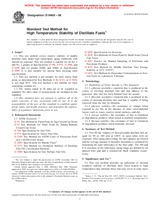
ASTM D6468-06
Standard Test Method for High Temperature Stability of Distillate Fuels
Automaticky přeložený název:
Standardní zkušební metoda pro vysokou teplotu stability destilátu paliv
NORMA vydána dne 1.5.2006
Informace o normě:
Označení normy: ASTM D6468-06
Poznámka: NEPLATNÁ
Datum vydání normy: 1.5.2006
Kód zboží: NS-35249
Počet stran: 6
Přibližná hmotnost: 18 g (0.04 liber)
Země: Americká technická norma
Kategorie: Technické normy ASTM
Anotace textu normy ASTM D6468-06 :
Keywords:
distillate fuels, fuel insolubles, high temperature stability, storage stability, thermal stability, ICS Number Code 27.060.10 (Liquid and solid fuel burners)
Doplňující informace
| Significance and Use | ||||||||||||||||||||||||
|
This test method provides an indication of thermal oxidative stability of distillate fuels when heated to high temperatures that simulate those that may occur in some types of recirculating engine or burner fuel delivery systems. Results have not been substantially correlated to engine or burner operation. The test method can be useful for investigation of operational problems related to fuel thermal stability. When the test method is used to monitor manufacture or storage of fuels, changes in filter rating values can indicate a relative change in inherent stability. Storage stability predictions are more reliable when correlated to longer-term storage tests, for example, Test Method D 4625, or other lower temperature, long-term tests. When fuel samples are freshly produced, aging for 180 min, instead of the traditional 90-min interval, tends to give a result correlating more satisfactorily with the above methods (see Appendix X2). The test method uses a filter paper with a nominal porosity of 11 μm, which will not capture all of the sediment formed during aging but allows differentiation over a broad range. Reflectance ratings are also affected by the color of filterable insolubles, which may not correlate to the mass of the material filtered from the aged fuel sample. Therefore, no quantitative relationship exists between the pad rating and the gravimetric mass of filterable insolubles. |
||||||||||||||||||||||||
| 1. Scope | ||||||||||||||||||||||||
|
1.1 This test method covers relative stability of middle distillate fuels under high temperature aging conditions with limited air exposure. This test method is suitable for all No. 1 and No. 2 grades in Specifications D 396, D 975, D 2880, and D 3699 and for grades DMX and DMA in Specification D 2069. It is also suitable for similar fuels meeting other specifications. 1.2 This test method is not suitable for fuels whose flash point, as determined by Test Methods D 56, D 93, or D 3828, is less than 38C. This test method is not suitable for fuels containing residual oil. 1.3 The values stated in SI units are to be regarded as standard. No other units of measurement are included in this standard. This standard does not purport to address all of the safety concerns, if any, associated with its use. It is the responsibility of the user of this standard to establish appropriate safety and health practices and determine the applicability of regulatory limitations prior to use. |
||||||||||||||||||||||||
| 2. Referenced Documents | ||||||||||||||||||||||||
|
Doporučujeme:

Aktualizace technických norem
Chcete mít jistotu, že používáte pouze platné technické normy?
Nabízíme Vám řešení, které Vám zajistí měsíční přehled o aktuálnosti norem, které používáte.
Chcete vědět více informací? Podívejte se na tuto stránku.